Wednesday, 29 February 2012

WDYTYA Live: A Newbie’s Perspective

I’m now back home after having spent the weekend in London at ‘Who Do You Think You Are? Live’. I had a fantastic time, met a lot of great genealogy people and very nearly lost my voice (it didn’t help that I arrived with a bad cold)! 

It was my first time at WDYTYA Live and my first visit to a major family history fair for several years. Having heard about the great time everyone had last year, I decided it was finally time I made the trip and I decided to make a weekend of it, arriving Friday lunchtime and leaving on Sunday afternoon.

The exhibition hall at 'Who Do You Think You Are? Live' 2012
Unsurprisingly for a show that describes itself as ‘the biggest family history event in the world’, WDYTYA Live was definitely the biggest and the best genealogy fair or conference that I’ve attended. With a well-known TV brand name behind it, the show attracts family historians from all over the UK as well as from Europe and the US. 

I’m very glad that I went, but I did feel that WDYTYA Live suffered from the same problem that has put me off from attending family history fairs for a few years - namely, a lack of substance. I did expect the event to be a bit bigger and if you’re the sort of person who already subscribes to one or two of the major commercial websites and keeps up with what’s happening in the family history world by reading magazines or blogs, it would be very easy to walk around the entire event in an hour or two and come away feeling that you hadn’t really learnt much that you didn’t already know. 

Although I did buy a couple of books (some secondhand), I didn’t find a lot to tempt to me to open my wallet and as these days it’s so easy to shop around online for a cheap deal, often with free postage, I didn’t particularly feel the urge to splurge on heavy books which I’d then have to cart home with me. It’s a shame that there weren’t more family history societies attending (especially some Scottish ones) as it would have been a good opportunity for them to sell their own, probably lesser known, publications, although I can understand that the expense of a stand and the need for volunteers to serve on it makes things difficult for many of the smaller societies. 

The best part for me was the opportunity to meet up with a large number of other professional genealogists as well as genealogy bloggers, tweeters and writers, many of whom I know through social media but hadn’t met in person before. I had plenty of good chats over coffees, dinners and drinks and there are many people I wish I’d had more opportunity to chat with. 

Now, with one entire event’s experience under my belt, I thought I’d draw up a short list of ‘dos’ for WDYTYA Live that I hope to put into practice next year: 

Do Volunteer - There seemed to be plenty of complimentary tickets going round for those who helped on stands or served as experts in the ‘Ask the Experts’ area. In most cases you only needed to help out for an hour or two and could then have the rest of the day to enjoy the show. Helping out is also a good way to feel involved and to get chatting with a lot of other people. (Note: You still need to fund your own travel and accommodation though). 

Do Plan in Advance - I attended a couple of workshops but really wished I could have been to a few more. The popular ones sell out early so it’s no good waiting until you fancy a sit down and then expecting to get into a talk, you need to get tickets as soon as you arrive. It’s also probably a good idea to work out in advance which exhibitors you particularly want to visit to avoid aimless wandering. 

Do Make Yourself Known - There were a few people that I’ve discovered were at WDYTYA Live that I didn’t get to meet. The tweeter/blogger rosettes organised by Else Churchill of the Society of Genealogists were a good idea as they stood out from the name badges worn by many of the exhibitors. Next time perhaps they could have something other than ‘Follow Me’ written on them though. After the third gentleman of a certain age came up to me and asked, “Where to?” the joke began to wear a little thin! 

Do Arrange To Meet - Even with the rosettes it was very easy to miss people in the large exhibition hall. Having a few mobile numbers and making some arrangements in advance definitely helped when it came to meeting up with people, especially those who were only there for a short time. I hear rumours of a possible ‘tweet up’ area at next year’s show which would be very useful. 

Do Have A Good Time!  - Hope to see you all there next year!

Saturday, 21 January 2012

Naming Baby

When researching Scottish families it’s common to come across the same forenames repeated through the generations. Whilst this can sometimes lead to confusion (I’ve recently researched a family in which seven generations of men had the same name!) it can also be very useful for confirming that you have the right family, especially when a traditional naming pattern was used. 

Kinkell Baptismal Font (now in St John's Episcopalian Church, Aberdeen)
Photo by Nick Thompson

It’s rare to find the relative after whom a child was named specifically stated, so I was interested to come across these entries in the register of Comrie Associate Congregation, concerning children of the minister, Samuel Gilfillan: 

National Records of Scotland ref. CH3/608/1 

13th May 1809
Same day in the afternoon my own Son
was baptized by Mr Wallace his name is
Samuel after myself Samuel Gilfillan died the
15 Febry 1810 - aged 7 months
and 15 days - of a croup

Comrie 8 May 1816
My own daughter was baptized to day
by Mr Scott, Crieff - Her name is Martha
Rankine, after my Mother and the Surname
of my Mother in law, Mrs Barlas - Martha Rankine
Died suddenly on the 30th Decr. 1816.-
If an unexpected name (particularly one including a surname) crops up in your family it can sometimes be because the child was named after the minister who baptised them. The Comrie Associate Congregation register also provides evidence of this: 
Comrie 9th Feby 1817
Baptized a Son to day to Peter Millar
one of my Elders, his name is Samuel - after my
self - Deus benedicat

Glentarken 2d Decr 1817
Baptized a Son to Daniel Carmichael named
Samuel - after myself - Deus benedicat - Samuel
Carmichael died soon after he was baptized
The Reverend Samuel Gilfillan died in 1826 but his name seems to have lived on among Comrie families.   A google search for his name brings up an entry in the Australian Dictionary of Biography for Samuel Gilfillan McLaren, born in Comrie in 1840, and information on the Reverend Samuel Gilfillan Carmichael, born in Comrie in 1871. 

According to his entry in Fasti, the Reverend Samuel Gilfillan Carmichael was the son of another Samuel Gilfillan Carmichael and his wife Janet Miller, so he may well have been connected to the Millar and Carmichael families mentioned above. 

I haven’t found a child named after a minister in my own family, but I have come across another reason for a child being given a particular name which is sometimes overlooked - that of being named after a relative through marriage (rather than a blood relative). One of my great-aunts was named after her step-grandmother (two older sisters being named after the actual grandmothers). I’ve also researched a family in which two brothers-in-law named a son after each other.


The reason that a child was given a particular name may not be immediately obvious but it can be worth investigating as it may provide evidence of a network of family connections, reveal the parents’ religious or political beliefs, or the allegiances felt to an employer or landowner.

Saturday, 3 December 2011

The British Newspaper Archive: A Great New Genealogy Resource


This week the genealogy world has been all atwitter with news of the official launch of the The British Newspaper Archive.  This is a joint venture between The British Library and brightsolid (the company behind ScotlandsPeople and FindMyPast) to digitise and make available online up to 40 million newspaper pages from the collection of the British Library.
At the time of writing there were over 3.1 million pages on the website but this is added to daily.  These include titles from England, Scotland, Wales, Northern Ireland and the Republic of Ireland.  Available date ranges vary considerably but there are some titles from the early 1700s and others that go up to the 1940s.  Some of the newspapers have been previously available through the ‘British Newspapers 1600-1900’ database (which is free to access through many libraries in the UK and elsewhere) but others are online for the first time.
An introduction to The British Newspaper Archive from BNArchive containing interviews with Ed King, Head of the British Library's Newspaper Collection, and Chris van der Kuyl, Chief Executive of brightsolid.
The archive is free to search but to view results it is necessary to purchase a subscription.  You can search by keywords or exact phrase and can filter your results by place of publication, publication title, date and article type.  You get quite a lot of information with a free search: title and date of the newspaper, article title & type, page number and a snippet of the text containing your search words (generated through OCR).  Although the OCR is far from perfect, in many cases this gives enough information to determine whether an article to likely to be relevant to your search.
A rather handy feature is that it is possible for users to correct the OCR generated article text, making it easier for others to find the same article.  I’ve added corrections to a few articles I’ve looked at, but it is a bit laborious.  You can also add tags to articles and bookmark them in different folders (for example, you could create separate folders for each branch of your family) and the site keeps a list of viewed articles under ‘My Research’ so you can easily go back and look at something again without using up credits.
I’ve had a lot of fun over the past few days searching for articles mentioning my ancestors and a lot of success.  I’m pretty lucky in that there are two titles covering the area where my Scottish mining ancestors lived and, as they have been digitised in colour (rather than in B&W from microfilm), the OCR is relatively accurate.  I am also lucky (or should that be unlucky?) in that my ancestors seem to have had rather a lot of brushes with the law!
This is a fairly typical example:
The Falkirk Herald and Linlithgow Journal
Wednesday, October 17, 1894.
Page 4, Column 6
BREACHES OF THE PEACE. -Susan Gilmour or Miller, Isabella Wilson or Broadley, Elizabeth Gilmour or Keenan, Agnes Donaldson or Gray, Sarah Miller or Gray, and William Gray, all residing at Southfield, Slamannan, were accused of having created a disturbance there on the 12th inst.  They, with the exception of William Gray, who pleaded not guilty, admitted the charge.  The Fiscal said he was prepared to accept the plea of the man Gray, as the ladies seemed to have been the aggressors in the affair. (Laughter.)
I haven’t yet worked out the relationships between all of these people, although the several shared surnames suggest this may have been a disagreement between extended family.
One of the criticisms I’ve seen of The British Newspaper Archive is the amount of duplication between it and other existing databases.  I’ve actually found this an advantage as the search options are much more user friendly and the fact you get a preview in your search results means it’s easier to spot relevant articles.  I’ve also found that performing identical searches returns more results with The British Newspaper Archive than with British Newspapers 1600-1900, and I’ve found some new information on my Yorkshire ancestors, even though I’ve searched the same newspapers previously.
A bigger problem is that using the download feature results, in my experience, in an illegible image in the majority of cases.  The only way to save a readable image that I’ve found is to go into ‘Full Screen View’, zoom in as much as possible (whilst keeping the entire article on screen) and then use your computer’s ‘print screen’ facility.  You can then crop the resulting image to show just the relevant article.  This works fine with a short article, but not with one in a long column or one that goes over several columns in a large broadsheet.
Another minor irritation is that when viewing an article your search terms aren’t highlighted, as in other newspaper databases.  This means you may have to read through several articles to find the one you want.  A way round this is to open the ‘Show Article Text’ box and then use your browser’s ‘Find’ command to locate your search term.  When you click on a line of text in ‘Article Text’ the same line is highlighted on the image.
A greater criticism relates to the price of subscriptions.  There are three options: a 12 Month Subscription costs £79.95 GBP and is described as Unlimited (but actually restricts you to 1000 pages a month); a 30 Day Package costs £29.95 GBP for 3000 credits; and a 2 Day Package costs £6.95 GBP for 500 credits.  Somewhat confusingly, the amount of credits needed to view one page varies depending on which package you have, the date of the article and whether it’s in colour or B&W.
I’ve taken out a 2 Day Package. So far I’ve found 21 articles relating to my family (a few I looked at weren’t relevant) and I’ve still got over 200 credits left.  I actually think that’s pretty good value when you consider that £6.95 is less than the cost of one BMD certificate and less than the cost of 30 credits on ScotlandsPeople.  In many cases it’s information I couldn’t have easily found elsewhere and although I could have looked at some of the newspapers at the National Library of Scotland, I would have had to visit in person, wait 30 mins for the microfilm to be delivered, scroll through a possibly poor quality microfilm and then pay for every print I wanted (providing, of course, one of the few microfilm printers was available and working).
However, I can’t see many family historians being willing to pay nearly £80 to subscribe to a website that only offers newspapers and the fact that the credit packages only last 2 or 30 days is definitely not ideal.  I’m not sure I will use all my credits in 2 days and it will be annoying to lose them.  As more titles are added in the future I may well find additional articles of interest and could end up having to take out another 2 day package every time I want to view just one article. 
I presumed that the subscription packages were aimed more at the academic researcher than the family historian but from reading others’ blogs and tweets it’s clear that researchers who are heavy users of online newspapers find the limit of 1000 pages a month far too restricted.  For a more detailed review by an academic historian who specialises in newspaper research I recommend the digital victorianist’s Review: The British Newspaper Archive.
I hope you have as much success in locating your ancestors in The British Newspaper Archive as I did.  It’s certainly worth trying out and you never know what you may find....

Sunday, 27 November 2011

More Records of the Edinburgh Poor


A few months ago I wrote about the Lists of the Edinburgh Poor held at Edinburgh City Archives, which cover the period 1869-1884.  I’ve recently been researching an individual who was on the Edinburgh poor roll at a later date and once again found that, whilst it is true that the majority of Edinburgh poor relief records have been lost, it is possible to find some information about those in receipt of poor relief.

Edinburgh City Archives is housed within the City Chambers
The records I was examining were the minutes of Edinburgh Parish Council from the late 1800s and early 1900s.  Edinburgh Parish Council existed from 1895-1930 and incorporated the former Edinburgh and St Cuthberts Combination Parochial Boards as well as parts of Liberton, Duddingston and Leith.  Among the Council’s responsibilities were the Craiglockhart and Craigleith Poorhouses as well as other institutions within the Edinburgh area.
Despite having previously been told that the chances of finding any mention of a particular individual within the minutes was pretty slim, I found that they were full of names; and for some periods names are even indexed at the front of each printed volume of minutes.
The information on children, especially those who were boarded out, is particularly detailed as these examples show:
Edinburgh City Archives ref. SL14/1/7 - Edinburgh Parish Council: Minutes of Council and Committees From 17th June 1901 to 21st Oct 1901. Edinburgh: James Turner & Co., 1902.
Pages 92-93
Children’s Committee.
Wednesday, 9th October 1901.
786C
Joan Davidson, Prestonkirk, taken off roll by Grandmother on 3rd September, and working to Mr Smith, Factor, Whittinghame. Wages 8s. a week.

611C
James Weir, Lanark, ran away on 20th August. No trace of him can be got - supposed to be working. Police to be communicated with again, and if no word of the boy within a fortnight, the Clerk to advertise and offer a reward of 20s.

886, 892C 
Edward Byrne, and David Brown, Gladsmuir. The Visiting Committee recommend a Topcoat for each. Grant.

877C
Mary Douglas, 12, with her Sister in London. Doctor reports her a confirmed Epileptic, and should be in an institution. Clerk to enquire and report as to any institution suitable for the treatment of this girl.

2906R
William, Henry, Roderick, and Winifred Young, in Craiglockhart Poorhouse with Mother. Deserted by Father. Advertise for Father.

2219R
James Sandilands, in Craiglockhart Poorhouse with Mother. Illegitimate. Delay for a month.
Note: The numbers against each child’s name seem to be case numbers, although any records to which these numbers refer do not survive.
In addition to children, the names of ‘lunatics’, paupers suffering from some illness and whose cases were considered by the Medical Committee and those whose place of settlement was debated are frequently mentioned, often with at least some brief details.
Whilst not everyone who received poor relief will be mentioned by name in the minutes of Edinburgh Parish Council, in the absence of other records they are certainly worth a look and may well provide some explanation of how an ancestor fell on hard times.

Monday, 7 November 2011

A Question of Religion

Last week I made a research trip to Paisley Local Studies Library and among the sources I looked at were poor relief records.
Poor relief records are a fantastic resource often revealing not only why our ancestors had to resort to asking for help from the poor law authorities but also providing details of their births and families.

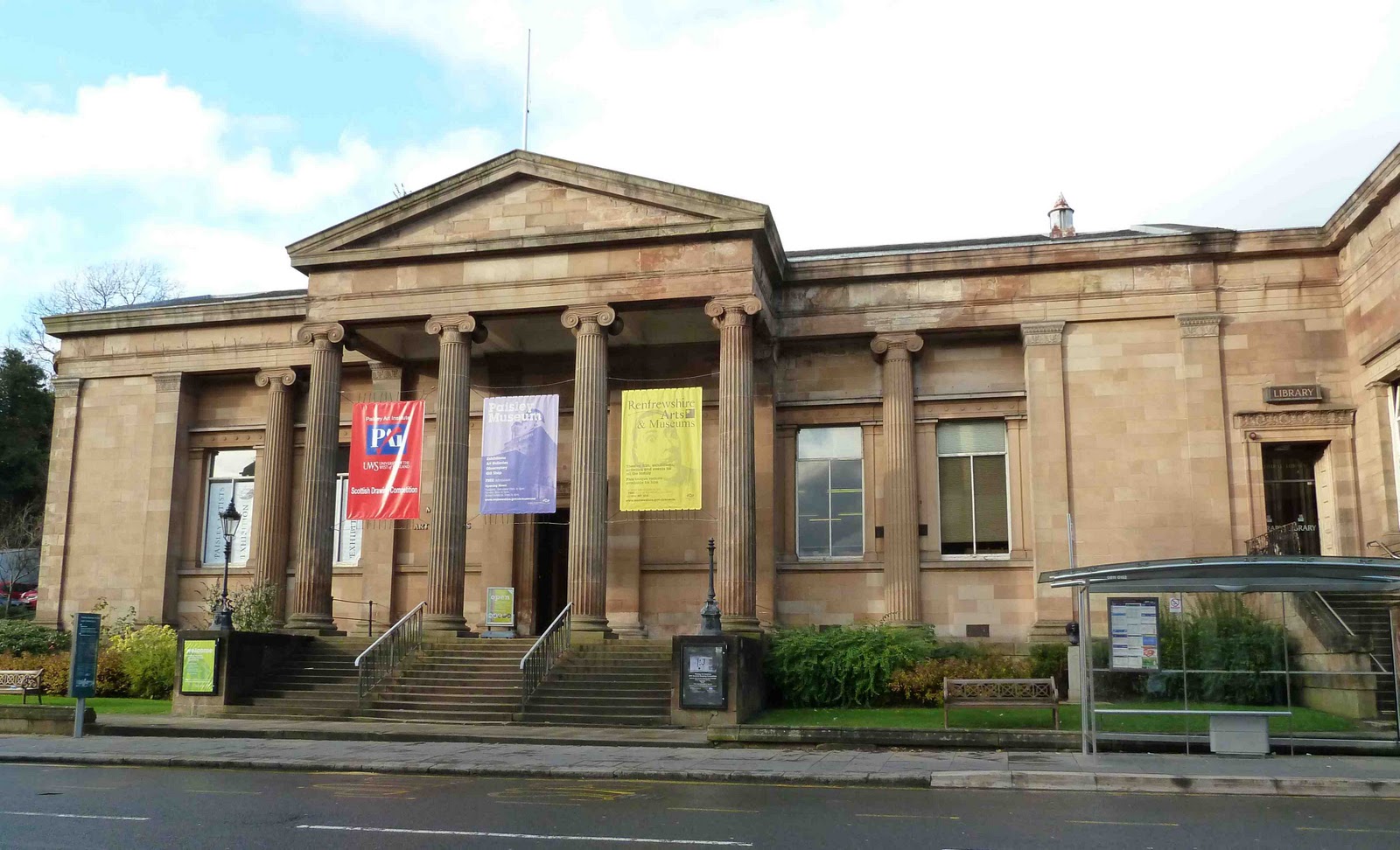
Paisley Museum & Library where the local studies collection is housed
When browsing a volume of poor relief applications I was particularly struck by the answers given in response to the question of ‘Religious Persuasion’.  These represented a wide range of religious denominations including Secessionists, Methodists, Baptists and Relief Church as well as reflecting Paisley’s large Irish population which included both Roman Catholics and Protestants (some described as Church of England or Episcopalian).
It seems to have been relatively common for husbands and wives to belong to different churches and what was perhaps surprising was the irregularity with which many people appear to have attended any church.  The following are a sample of answers found in volume B57/11/1 ‘Paisley Parochial Board: Statements of Cases’ which covers 1839-1842:
Mrs Archibald Gibson, aged 66
West Relief Church formerly, but never attended nor members for 30 years
Mrs Peter Docherty aged 31
Roman Catholic: self a member and husb[an]d is not
Walter Millar, aged 61
formerly in his younger days, he was a member of the Abbey Cl[ose] Independent
Widow William Cumming, 77
Church of Scotland: Once a Communicant but not so for some years
George Stewart, 40
Church of Scotland: but never has Communicated
Hellen Cavannah, 58
has a disposition towards the Roman Catholic faith; not a Member
Widow Thomas Campbell, 56
Protestant: Once attended but not so for many years
Widow Malcolm Turner, 76
neither herself nor husband were members of any church
It is worth noting that in Scotland, often only the fairly well-to-do were actually communicants or full members of a church (as opposed to simply attending) and it is not uncommon to find that a couple married in a particular church and had all their children baptised there without ever appearing on the communion roll.
However, given these answers, locating these people in any church records may well be a challenge and it is quite likely that many of them died prior to the start of statutory registration (1855).
I’ve often had the impression that my Scottish ancestors rarely darkened the door of any religious establishment.  Given this evidence, I may well be right!

Wednesday, 26 October 2011

On the verge of a new life...

I’ve just spent a busy but productive day at the ScotlandsPeople Centre and whilst researching a client’s family from Argyll came across this interesting entry in the Old Parish Register for Kilchrenan and Dalavich: 


OPR 517: Parish of Kilchrenan and Dalavich, Argyll 

Register of Marriages in the United Parishes of Kilchrenan and Dalavich 
1821 
June 5 Peter Macffarlane late at Airdchonnal & 
          Elizabeth Campbell at Kames. Were Married this day 
                            at the Manse of Kilchrenan by 
                            Mr William Fraser Min[iste]r 
                            and were furnised [sic] with a certifi-
                            cate of their Marriage & Moral 
                            Character as they with his Father 
                            and family are preparing for Emigrating 
                            to Upper Canada. 


It’s one of those times when the clerk thought to note down at bit more than just the bare facts and it paints an evocative picture of a young couple on the verge of a new life. I think Elizabeth must have been brave to leave her own family behind and head off into the unknown, but perhaps she couldn’t bear the thought of Peter sailing off without her!

Saturday, 8 October 2011

Getting Educated

Genealogy education is a topic that’s been on my mind quite a lot lately. Firstly, I just heard that I’ve successfully completed the Postgraduate Diploma in Genealogical Studies from the University of Strathclyde. Secondly, I’ve recently joined a ProGen Study Group and one of my first assignments was to draw up an education plan for the next few years. And finally, last month I attended an AGRA Associates Day in London where the main theme was Continuing Professional Development. 

I think it’s fair to say that education is a pretty hot topic in the genealogy world right now. I’ve read two articles on the subject in the last few weeks: 'A Qualified Success' by Suzie Grogan in the October 2011 issue of Family Tree Magazine (UK) and 'The Art of Teaching Genealogy' by Lisa A. Alzo in the September 2011 issue of Association of Professional Genealogists Quarterly. Geneabloggers Radio had a 'Back to School Special' devoted to genealogy education in August and Angela McGhie, administrator of the ProGen Study Groups, writes a blog, Adventures in Genealogy Education, devoted to the subject. 

It’s clear that there’s a great demand for education from genealogists, whether tracing their own families, researching professionally or aspiring to become professional. Not surprising perhaps as genealogists are typically people with a thirst for knowledge and, I suspect, generally optimists who believe that the answer to finding that elusive ancestor is out there somewhere, if only they knew where to look. 

Last year when I completed the Postgraduate Certificate in Genealogical Studies I wrote a post about my experience of the course. You can read that post here and much of what I said also holds true for the Diploma course. This year, whilst considering ideas for my continuing education, I thought I’d write a brief summary of available genealogy education options from a UK perspective. 

Long-term Courses 
For those seeking an in-depth programme of study lasting several years there are three main options in the UK. The University of Strathclyde Genealogical Studies Programme, The Institute of Heraldic and Genealogical Studies (IHGS) Correspondence Course in Genealogy and the University of Dundee Courses for Family and Local History (leading to a Postgraduate Certificate or Masters Degree). 

All of these courses are available online for distance learning. I don’t have personal experience of them all, but one of the main differences seem to be that the Strathclyde course involves intense study with assignments submitted to meet regular deadlines, whilst the IHGS course can be completed at the student’s own pace and the Dundee course is modular with students having some choice over what modules to complete and how many modules to undertake at a particular time. 

Short-term Online Courses 
For those looking for a shorter course, Dundee University also runs two online distance learning courses entitled Beyond the Internet and modules from it’s main genealogy course can be taken individually (although a £95 registration fee applies). 

The main provider of short-term online courses in the UK is Pharos Tutors who are currently offering about 40 individual courses on a variety of genealogical topics. The National Institute for Genealogical Studies is based in Toronto, Canada but offers courses on English, Irish and Scottish research from basic to advanced levels. Some courses are non-credit but others are credited and can be used to gain a Certificate in English, Irish or Scottish Records. Celia Heritage of Heritage Family History has created a 4-module e-Course which can be purchased and downloaded from her website. 

Short-term Local Courses 
There are many genealogy courses available throughout the UK which can be attended in person. These are typically provided by university lifelong learning departments, adult education programmes, family history societies, libraries & record offices and private individuals and range from beginner’s workshops to advanced courses on particular record types. 

Free & Low-cost Options 
The above courses, especially the long-term ones, involve a serious investment of time and money, which not everyone is in a position to make. However, one of the things which was stressed in both my ProGen reading and at the AGRA Associates Day was that genealogy education doesn’t have to involve an organised programme of study. I hadn’t previously viewed many of my activities related to genealogy as educational or fully appreciated how much I was learning all the time. Below are are few of the other ways us genealogists can educate ourselves. If you’re the type of person who regularly reads genealogy blogs then chances are you already participate in quite a few of them. 

Webinars are a topic I’ve heard a lot about lately, although they’ve yet to make much of an appearance in the UK. The Society of Genealogists held a webinar on Using Legacy Software a few months ago and hopefully there will be more to come. In the meantime, there are plenty of webinars available from the US which are relevant to genealogists worldwide. Legacy Family Tree is a major provider of webinars and if you are not able to attend live then many recorded ones are available from their website (in some cases they are available free for a limited time and can be purchased after that). GeneaWebinars provides details of upcoming genealogy webinars and a calendar to keep track of them all. 

FamilySearch Learning Center offers a growing collection of videos and recorded lectures, described as free courses. There are currently 66 in the UK category (some of which are actually lectures from The National Archives available elsewhere) and others, for example in Instructions and Methodology, which are not location specific. These range from the ‘5 Minute Genealogy’ series for beginners, to advanced topics lasting about an hour. A recent addition is Scotland’s Old Parish Registers: How to Access, Use and Interpret. Nick Barratt, editor of Your Family History magazine, has an online video series on YouTube called The Family History Show. So far there have only been a few pilot episodes but hopefully more will follow. 

Podcasts are a good way to keep up with the latest news in the genealogy world and to increase your knowledge. The Genealogy Guys Podcast and Genealogy Gems Podcast are both US-based but frequently cover UK news and sources. The BBC radio programmes Tracing Your Roots and Digging Up Your Roots can both be downloaded as podcasts (but only for a short time after they are broadcast) and Geneabloggers Radio can be listened to live online or downloaded as a podcast. The National Archives (UK) Podcasts are recordings of lectures held at TNA and cover family, military and social history. There are currently over 70 lectures in the family history section covering topics from 'Sources for Anglican Clergymen' to 'The Pub and the People'. 

Genealogy books and magazines are another good low-cost education option and you don’t necessarily have to buy them. A simple keyword search for ‘genealogy’ on my local library catalogue returns over 900 titles and whilst some of these are transcriptions and indexes (as well as duplicates) this still provides plenty of educational reading. Membership of most genealogy societies includes a subscription to the society’s journal and allows you to attend talks given by the society. Talks, lectures and workshops are also hosted by local history societies, libraries, archives and educational organisations and whilst these may not always be specific to genealogy they can help to broaden our genealogy education. 

At present, ProGen is the focus for my genealogy studies but my wider education plan involves most of these free and low-cost options. What about you? What other forms of genealogy education do you participate in?