Showing posts with label Poor Relief. Show all posts

Saturday, 27 October 2012

Scottish Local History Forum Conference

Yesterday I attended the Scottish Local History Forum Conference at the AK Bell Library in Perth. The theme of the conference was “For Reliefe of the Pure and Impotent”: Welfare in Scotland before the Welfare State and it comprised nine talks on a broad range of topics connected to the poor in Scotland. 

The day began with Robin Urquhart from the National Records of Scotland giving an overview of poor relief in the period 1560-1894. This provided a useful background to the rest of the talks. Next, the Rev. Dr. Johnston McKay discussed Thomas Chalmers’s Glasgow experiment and the differing opinions as to whether or not it was a success. 

Dr. Irene O’Brien “painted the local picture in the west of Scotland” drawing upon the collection of records held at the Mitchell Library in Glasgow. Having heard Dr. O’Brien speak before, some of the material was familiar to me, but the statistics she provided were particularly interesting - for example, that in the 1890s only 20% of those receiving poor relief were living in the poorhouse, the majority receiving outdoor relief. I also hadn’t appreciated the compulsion on single mothers (widows, the deserted and mothers of illegitimate children) to enter the poorhouse, primarily to prevent them having more children! 

Iain Flett from Dundee City Archives described the poorhouses that existed in Dundee from the 1500s to the 1900s. Unfortunately, the fate of most of Dundee’s poor registers reflects that of Edinburgh’s, having been deliberately destroyed because people wanted to look at them, although records do survive for the East Poorhouse. This was followed by Gordon Douglas speaking (and singing!) about the Mars Training Ship. Although I’d heard of the Mars, I was unaware that it took boys from all over Scotland or that around half of them came from Glasgow (especially Catholic boys who were not accepted by many institutions). 

After lunch, Dr. Malcolm Bangor-Jones discussed growing old in 19th century Sutherland, providing an interesting contrast to the earlier talks on the urban poor. He mentioned the role played by landlords and the information to be found in estate records, particularly the Sutherland Papers. Patricia Whatley from the University of Dundee described medical services (or rather the lack of them) in the Highlands 1845-1913, concluding with the Dewar Report and the creation of the Highlands and Islands Medical Service, a forerunner of the NHS. 

The final talks were by Dr. Eric Graham on The Incorporation of the Masters and Assistants of Trinity House and their role in caring for the seafaring community, and Elizabeth Henderson on Friendly Societies in West Lothian. Both talks highlighted that relief of the poor was not only the concern of the church or the parochial boards, and that self-help through membership of a trade incorporation or friendly society was also important. 

I definitely learnt a lot and had a great day. My main criticism would be that as each speaker only had a 25-30 minute slot they had to gallop through their material at quite a pace, which in every case could easily have filled a hour or more. However, this did mean that a broad range of topics were covered, if not in depth, and this really emphasized the wide variety of records available for studying the Scottish poor. Although there were plenty of genealogists in the audience, I didn’t get the impression that most of the speakers had ‘dumbed-down’ for a family/local history audience, which made a pleasant change. 

Some of the main points I took away from the day were: that the change from the Old Poor Law to the New Poor Law was more a change in administration than a fundamental change in policy; that despite the threat of the poorhouse being used as a test of destitution, the most common experience of the poor in Scotland was one of outdoor relief; and that poor relief was not intended to be a sole means of support but rather topped up the help received from other sources. 

I was very interested to see several examples of printed poor rolls, similar to those I previously blogged about here that exist for Edinburgh. Apparently these were produced so that ratepayers could see who was getting their money and raise objections if they didn’t consider the recipients to be deserving! I would be interested to know how many of these printed lists of names survive for other areas of Scotland, as presumably producing them was a fairly common practice. 

Patricia Whatley kindly mentioned my Records of the Scottish Poor list during her talk, and as a result of attending the conference I’ve added a few more details. 

The next conference from the Scottish Local History Forum will be the Spring Conference and Local History Mini Fair to take place in Kinghorn, Fife on 26 April 2013. The theme is ‘Salt, Sun & Shivering: Scots at the Seaside 1750-2000’. Although this may not be of quite as much interest to genealogists, I’m sure it will be another enjoyable day. 

I’ve previously been disappointed that there doesn’t seem to be much in the way of conferences for genealogists in the UK, beyond the very basic talks given at most family history fairs. Although the SLHF Conference was not aimed specifically at genealogists (or perhaps because of that), it provided a great deal of information about an important genealogical source. 

With the Previously... Scotland’s History Festival in Edinburgh next month, the Scottish Association of Family History Societies conference to be held in Galashiels in May 2013, planned celebrations for the 60th anniversary of the Scottish Genealogy Society and the Halsted Trust Conference ‘Exodus: Movement of the People’ in September 2013, I look forward to attending a lot more conferences in the near future!

Sunday, 15 July 2012

Records of the Scottish Poor


Back in 2004, I remember reading the article Scottish Poor Law Records: An Invaluable Aid to the Genealogist by David W. Webster in the 8th edition of The Family and Local History Handbook.
The article discusses the value of Scottish Poor Relief records and the extent of surviving records, mentioning records for Glasgow, Ayrshire, Lanarkshire, Dunbartonshire and Paisley.  Webster wrote that, “elsewhere little appears to be widely known about extant poor relief records”.
Since that article was published, a lot has changed in the world of Scottish genealogy.  One of these changes has been that the holdings of local archives are now much easier to identify as many archives have added descriptions of their collections to the Scottish Archive Network (SCAN) catalogue, have their own online catalogues or have created finding aids and guides to their records (some designed specifically for family historians).
This means that is now fairly easy to locate surviving poor relief records from all over Scotland.  However (as far as I know!), no attempt has been made to bring together a list of the records held by different archives, so that it is necessary to consult a range of different catalogues and finding aids to determine what exists for any particular area.
And so I decided to create a list of ‘Records of the Scottish Poor’ covering the whole of Scotland.  This list is available as a PDF file on my website at www.myainfolk.com/Resources.html.  Like my previous list ‘Scottish Censuses, Population Listings & Communion Rolls (mainly pre-1841)’ (also available on my website), this grew out of a desire to have something I could quickly refer to when carrying out research for clients.  Also like my previous list, whilst I began with a clear idea of the types of records I would and wouldn’t include, this quickly expanded as I came across a whole host of records that sounded interesting, might be useful and should probably be included.
The current list is very much a work in progress and I hope to update it periodically.  Broadly speaking, I have included all registers of poor and volumes of poor relief applications that I could identify, and anything that seems to be a list of those in receipt of poor relief.  On the whole I haven’t included minute books, except where these are noted as containing lists of names or have been indexed.
I have relied heavily on online catalogues and a few reference books, and in some cases these only give very general details.  For example, for the counties of Inverness, Orkney, Ross & Cromarty, Shetland and Sutherland, I found that poor relief records survive for certain parishes for specific date ranges and that among these records are general registers of the poor, applications for relief and children’s registers, but have not established exactly what survives for each individual parish. 
I have included some records of poorhouses, hospitals and asylums, industrial schools, children’s homes and charitable organisations (mainly admissions registers and lists of names), although this is by no means comprehensive.  As a number of poorhouses later became hospitals, their records may be found in NHS archives.  In addition, many hospitals and asylums distinguished between regular and pauper patients, so that there is a certain amount of overlap between medical records and records of the poor.
As with most records, survival of records of poor relief is pretty patchy, with some counties having vast collections and others practically nothing at all.  As well as the well-known Glasgow poor law archives, Aberdeenshire, Angus, Banffshire, Dumfriesshire, Kincardineshire, Kirkcudbrightshire, Moray and Wigtownshire all have pretty good collections.
Conversely, very little survives for Fife, and I have been able to identify few records for the counties of Kinross or Nairn.  Whilst most Edinburgh poor relief records were destroyed, there are some records for the 1830s-1840s, as well as lists of poor for 1840-1884 which I blogged about previously here.
Taken as a whole, a remarkable number of records of the Scottish poor do survive - my list is so far up to 40 pages!  I was particularly interested to discover how much 20th century material there is, with the poor relief registers of some areas continuing up to the 1940s or even later.  Whilst this might seem somewhat academic as most records are subject to 75-year or 100-year closure periods, it does mean that some interesting discoveries await the family historians of the future.
In the above-mentioned article on Scottish Poor Law Records, David W. Webster wrote, “the potential value of the Scottish Poor Law records to genealogists is such that it is surely worthwhile considering a project covering all of Scotland to locate and computer index such records”.  

Whilst it is not yet clear what form it will take, the fact that the records for Aberdeenshire, Banffshire, Kincardineshire and Moray are currently being digitised in a project involving the National Records of Scotland, the Aberdeen and North East Scotland Family History Society and FamilySearch, suggests that such a project may finally be becoming a reality.
In the meantime, I hope that my list will enable other researchers to discover what records exist for the areas where their ancestors lived and where these records may be found.  If anyone has any additions or amendments to the information contained in the list I would be very grateful if you would let me know.  My contact details are listed below.
Happy hunting!

Kirsty F. Wilkinson

My Ain Folk

Sunday, 27 November 2011

More Records of the Edinburgh Poor


A few months ago I wrote about the Lists of the Edinburgh Poor held at Edinburgh City Archives, which cover the period 1869-1884.  I’ve recently been researching an individual who was on the Edinburgh poor roll at a later date and once again found that, whilst it is true that the majority of Edinburgh poor relief records have been lost, it is possible to find some information about those in receipt of poor relief.

Edinburgh City Archives is housed within the City Chambers
The records I was examining were the minutes of Edinburgh Parish Council from the late 1800s and early 1900s.  Edinburgh Parish Council existed from 1895-1930 and incorporated the former Edinburgh and St Cuthberts Combination Parochial Boards as well as parts of Liberton, Duddingston and Leith.  Among the Council’s responsibilities were the Craiglockhart and Craigleith Poorhouses as well as other institutions within the Edinburgh area.
Despite having previously been told that the chances of finding any mention of a particular individual within the minutes was pretty slim, I found that they were full of names; and for some periods names are even indexed at the front of each printed volume of minutes.
The information on children, especially those who were boarded out, is particularly detailed as these examples show:
Edinburgh City Archives ref. SL14/1/7 - Edinburgh Parish Council: Minutes of Council and Committees From 17th June 1901 to 21st Oct 1901. Edinburgh: James Turner & Co., 1902.
Pages 92-93
Children’s Committee.
Wednesday, 9th October 1901.
786C
Joan Davidson, Prestonkirk, taken off roll by Grandmother on 3rd September, and working to Mr Smith, Factor, Whittinghame. Wages 8s. a week.

611C
James Weir, Lanark, ran away on 20th August. No trace of him can be got - supposed to be working. Police to be communicated with again, and if no word of the boy within a fortnight, the Clerk to advertise and offer a reward of 20s.

886, 892C 
Edward Byrne, and David Brown, Gladsmuir. The Visiting Committee recommend a Topcoat for each. Grant.

877C
Mary Douglas, 12, with her Sister in London. Doctor reports her a confirmed Epileptic, and should be in an institution. Clerk to enquire and report as to any institution suitable for the treatment of this girl.

2906R
William, Henry, Roderick, and Winifred Young, in Craiglockhart Poorhouse with Mother. Deserted by Father. Advertise for Father.

2219R
James Sandilands, in Craiglockhart Poorhouse with Mother. Illegitimate. Delay for a month.
Note: The numbers against each child’s name seem to be case numbers, although any records to which these numbers refer do not survive.
In addition to children, the names of ‘lunatics’, paupers suffering from some illness and whose cases were considered by the Medical Committee and those whose place of settlement was debated are frequently mentioned, often with at least some brief details.
Whilst not everyone who received poor relief will be mentioned by name in the minutes of Edinburgh Parish Council, in the absence of other records they are certainly worth a look and may well provide some explanation of how an ancestor fell on hard times.

Monday, 7 November 2011

A Question of Religion

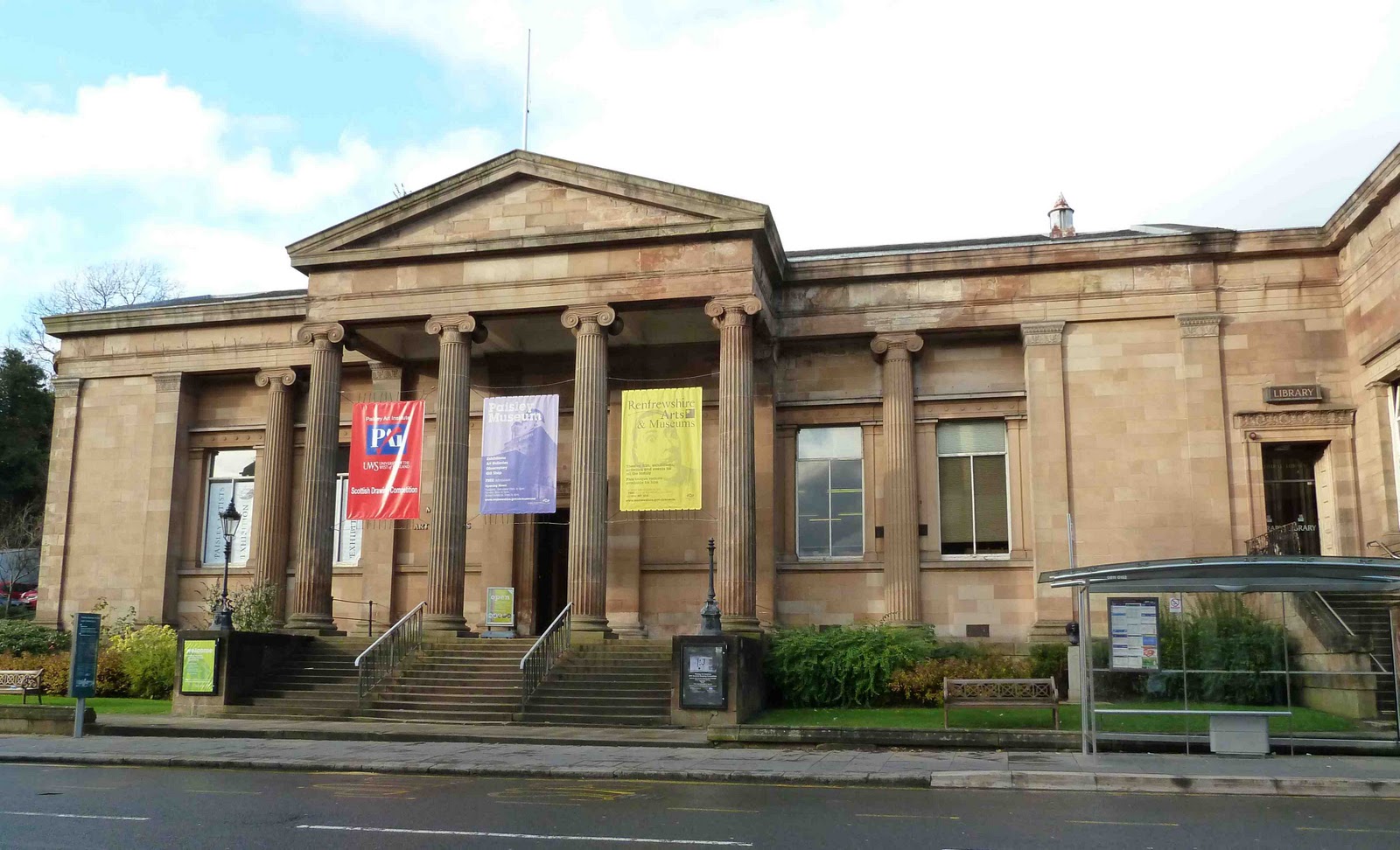
Last week I made a research trip to Paisley Local Studies Library and among the sources I looked at were poor relief records.
Poor relief records are a fantastic resource often revealing not only why our ancestors had to resort to asking for help from the poor law authorities but also providing details of their births and families.

Paisley Museum & Library where the local studies collection is housed
When browsing a volume of poor relief applications I was particularly struck by the answers given in response to the question of ‘Religious Persuasion’.  These represented a wide range of religious denominations including Secessionists, Methodists, Baptists and Relief Church as well as reflecting Paisley’s large Irish population which included both Roman Catholics and Protestants (some described as Church of England or Episcopalian).
It seems to have been relatively common for husbands and wives to belong to different churches and what was perhaps surprising was the irregularity with which many people appear to have attended any church.  The following are a sample of answers found in volume B57/11/1 ‘Paisley Parochial Board: Statements of Cases’ which covers 1839-1842:
Mrs Archibald Gibson, aged 66
West Relief Church formerly, but never attended nor members for 30 years
Mrs Peter Docherty aged 31
Roman Catholic: self a member and husb[an]d is not
Walter Millar, aged 61
formerly in his younger days, he was a member of the Abbey Cl[ose] Independent
Widow William Cumming, 77
Church of Scotland: Once a Communicant but not so for some years
George Stewart, 40
Church of Scotland: but never has Communicated
Hellen Cavannah, 58
has a disposition towards the Roman Catholic faith; not a Member
Widow Thomas Campbell, 56
Protestant: Once attended but not so for many years
Widow Malcolm Turner, 76
neither herself nor husband were members of any church
It is worth noting that in Scotland, often only the fairly well-to-do were actually communicants or full members of a church (as opposed to simply attending) and it is not uncommon to find that a couple married in a particular church and had all their children baptised there without ever appearing on the communion roll.
However, given these answers, locating these people in any church records may well be a challenge and it is quite likely that many of them died prior to the start of statutory registration (1855).
I’ve often had the impression that my Scottish ancestors rarely darkened the door of any religious establishment.  Given this evidence, I may well be right!

Tuesday, 12 July 2011

Lists of the Edinburgh Poor

I spent this afternoon at the Edinburgh City Archives which is hidden away in the City Chambers, three floors below the level of the Royal Mile.

The main reason for my visit was to examine some records I had identified through the SCAN catalogue, Edinburgh Parochial Board: Lists of Poor 1840-1884. 

This record consists of two volumes and I looked at the second of these which covers 1869-1884 (SL8/7/2). This is a printed volume entitled ‘List of Poor in Receipt of Relief from the City Parish of Edinburgh’ and for each year the names of those receiving poor relief are divided up into the the following sections: 

Out-Door Poor 
Inmates in Poorhouse 
Inmates in Lunatic Wards 
Inmates in Morningside Asylum 
Lunatics Boarded with Relatives 
Lunatics Boarded Out 
Paupers Boarded in Institutions 
Invalids Boarded Out 
Children Boarded Out 
Apprentices 
Edinburgh Poor in Country Parishes 
Country Parish Poor in Edinburgh Parish 
Children Receiving Education 

In the cases of children boarded out and apprentices only a name and identifying number are listed, but in most other cases an address or name of institution is also given. 

However, by far the most detailed section is for the out-door poor where the following information is provided: 

Roll Number 
Weekly Allowance 
Name 
Age 
Residence 
Number of dependants (Male and Female) 
Religious Denomination 
Whether Member or Adherent 
Any Assistance provided by the Church 
Remarks (generally how long each person has been a member of their church but also details of any illness or disability) 

The vast majority of those who received outdoor poor relief were women. For example, in 1882 Alice C. Peacock was receiving 4s 0d a week. She was aged 31, living at 7 Stanley Place, and had one male and two female dependants. She was recorded as a member of St Mary’s Episcopal Church, which she had attended for 1 year nine months, but received no assistance from them. 

The men who received outdoor relief were mostly elderly although there are a few exceptions. In 1882 Archibald Sandilands, who lived at 3 Greenside Row, top flat right, was in receipt of 6s 0d a week. He was aged 39 and had three male and two female dependants. He was a member of the Greenside Established Church which he had attended for 8 years but again received no assistance from them. 

Archibald, his wife Elizabeth, and their six children were recorded living at 3 Greenside Row in the 1881 Census (RD:685/2 ED:3 Page:11). His older children may well have been considered old enough to work and therefore not dependants. 

Unfortunately, I didn’t find the person I was looking for today, but these lists are well worth a look if you think your Edinburgh ancestors may have received poor relief. 

Further details of the holdings of Edinburgh City Archives and a list of those who claimed poor relief from St Cuthbert’s Parochial Board in the period 1850-1852 can be downloaded from http://www.edinburgh.gov.uk/downloads/429/archives-access 

Note: Edinburgh City Archives will be temporarily closed from 28 July until October 2011.

Sunday, 12 December 2010

Living the Poor Life in Glasgow: Part Two

Back in October I blogged about the Poor Law Archives in Glasgow and the fact that not everyone was happy with the poor relief they were offered, especially if that involved going to the poorhouse. 

In contrast, whilst searching through some online newspaper archives this week I came across a report of a man who, according to the authorities at least, was a little too keen to spend time in the Glasgow poorhouse: 

The Scotsman (Edinburgh, Scotland) 26th March 1902, p.8, col. 7. 

A LIKING FOR THE POORHOUSE.- Robert M’Ateer, 
an Irishman, was charged at Glasgow Sheriff Sum- 
mary Court yesterday with contravening the Poor- 
law Acts by becoming chargeable to the parish of 
Glasgow after the city authorities had, at this own 
request, sent him to his parish of settlement in 
Ireland. The evidence showed that accused, who 
was forty-three years of age, had been in the poor- 
house fifteen times. Sheriff Fyfe said that accused 
appeared to be one of those people who came over 
from Ireland and practically lived in the poorhouse. 
That sort of thing would not do; Glasgow was not 
going to keep all the vagrants who cared to come 
into it. Sentence of two month’s imprisonment was
passed.


Sunday, 17 October 2010

Living the Poor Life in Glasgow

This week my research took me to the fantastic Mitchell Library in Glasgow where I was mainly searching the Poor Law Archives. 


Whilst browsing through one of the 5000 volumes of Poor Law Records held there I came across a couple of entries that show that not everyone was satisfied with the help they were offered: 

Glasgow City Archives - Reference: D-HEW 10/3/3 

Page 7 
2nd June 1852 Hector Mc Niel aged 66 born in North Knapdale wife Margt Mc Niel aged 49 born in same place. Residing in 79 McAlpine St. - back low door, applies on account of age and says his wife and his oldest son are in ill health he has 2 Children Hector aged 13 and Catherine 10 years come the 15th Instant _ they came to Glasgow 4 weeks ago, and he is now in proces of prefering a complaint against the Inspector of Islay for inadequate relief afforded before he left Islay _ they Resided in the Parish of Kildalton Islay 7 years ending May last - certified by the Revd. James Dewar Minister, Donald McDougal Session Clerk and two Elders of that Parish, he first applied to the Inspector of Kildalton 1 year ago and has had ocasional relief since till octr last when he was enrolled @ 12/ monthly which he has since regularly received. up to 24 Apl last when his pass book shows he received the last 12/_ I gave him an order for 1/6, with which he was dissatisfied and I took it back _ and requested then to come up at 6 o clock to be admitted into the House _ it is now 8 o clock and none of then have yet appeared _ came up today and I gave a line of admission to the new House for self & Family, 4th June 52 

Page 68 
29 June 1852, Catherine Gouchan or Gallacher wid Jackson, aged 29 born in Ireland. Residing in 2 Jafferies Close, top flat, applies for Onely Child Mary aged 2 years May last born in Ireland who she says is in bad health, Her Husband John Jackson an Irishman died in Ireland 2 years ago and she came first from Ireland 1 year ago _ I gave a line for the house for self and Child on 30th June 52. 
Revisited 22 June 1853 at 15 Jafferies Close up 1, she now applies on account of being pregnant with an Illegitimate Child to a James Sullivan an Irishman of whom she pretends she knows nothing she says she remained in the House last year for 6 weeks, but complains that she was made to work hard &c while there which she thinks was very hard _ I requested her to come up again for a line to the Poorhouse at 5 o clock this evening - 29 June 53 

A further entry reveals the fate of Catherine’s daughter, Mary: 

Page 217 
27 Oct, 1852 Mary Jackson aged about 2 years, born in Ireland Residing at 2 Jafferies Close up 2, where she was left by her Mother Catherine Gouchan aged about 30, born near Bangor County Mayo Ireland, she has worked during harvest at drawfitting(?) near Coalbrig _ but returned lately to Glasgow and left the Child on Friday last under pretence of going out to beg _ she had lodged in the house before and applied here before in Augt last, and was admitted into the House _ the women in the house say they do not believe she will come back for her Child as they have heard her say she wished to be quit of her _ House 28 Oct 52 

Dr Irene O’Brien provides a great introduction to these records in a short video available here - one of a series of useful videos on the Family History resources held at the Mitchell Library.