Monday, 29 August 2011

The Scottish Genealogy Society's Black Book

Although I'm a member of the Scottish Genealogy Society, I don't often look at their website.  Today was one of the rare occasions when I did and I discovered a resource there of which I was previously unaware and which I thought was worth sharing.

One of the great resources of the Scottish Genealogy Society's library is the society's collection of monumental inscriptions.  This is claimed to be the largest collection in Scotland and includes many unpublished transcripts as well as publications produced by family history societies all over Scotland.

The Society has now made details of all their holdings relating to Scottish deaths and burials available online through The Black Book.  These are a series of pdf documents which can be viewed online or downloaded to your computer and which show what burial, death and monumental records and indexes are held at the library for each parish in Scotland.

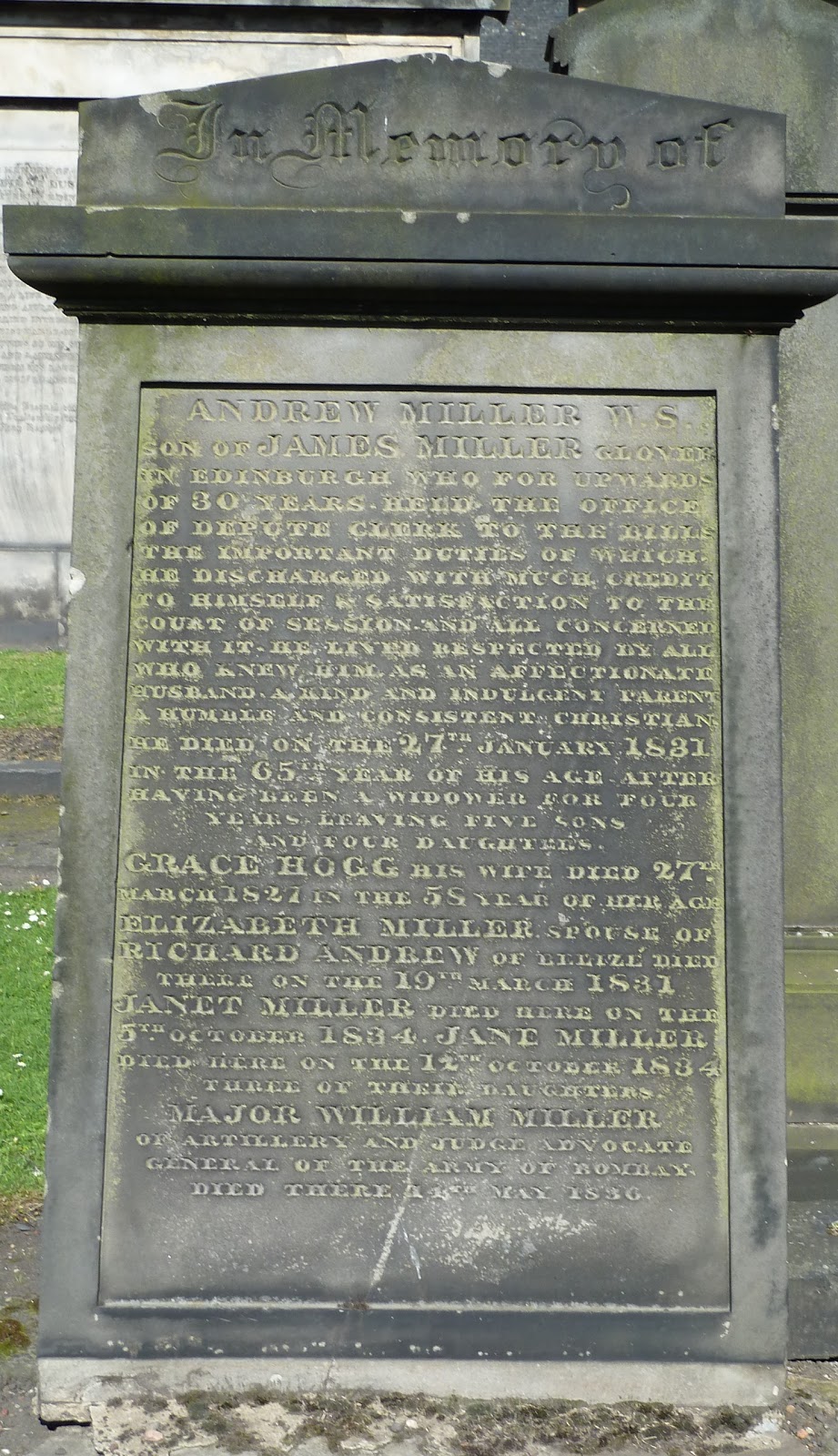
A Monument to the Miller family in Canongate Kirkyard, Edinburgh.

Even if you are not able to visit the Society's library in person to view the records and indexes, this acts as a very handy list of the majority of surviving records of Scottish deaths and burials prior to 1855.

Although not so comprehensive, it's also worth looking at the National Library of Scotland's Index of Published Monumental Inscriptions.  This includes details of some nineteenth-century publications containing monumental inscriptions as well as inscriptions published in journals such as Scottish Notes and Queries.  This index is only updated occasionally, however, so it is also recommended that you search the main library catalogue as well.

Whilst on The Scottish Genealogy Society's website don't forget that you can also download an index to The Scottish Genealogist journal covering 1953-2005 which includes plenty of articles on monumental inscriptions.

Happy searching!

© All images and text copyright Kirsty F. Wilkinson

Wednesday, 3 August 2011

Using LibraryThing for Genealogy

I have a confession. I buy books and never read them. I just can’t resist a second-hand bargain of some obscure history title that I may never see again or a new genealogy reference book that promises to help me break through that impenetrable brickwall. 

I have the best of intentions, but too often I just read the introduction, flick through a couple of chapters, then stick the book on my groaning bookshelves for "when I have more time". I’ve now reached the point where not only do I need a new bookcase, but I’ve also several times found myself in a bookshop looking at some inviting title and wondering if I already have it. 

Currently awaiting shelving.

I’ve recently seen a few of my Facebook friends discussing using LibraryThing as a way of cataloguing and sorting their book collection and decided to give it a try. I spent a few happy hours earlier this week going through my bookshelves and putting the majority of my history and genealogy titles online. 

According to Wikipedia, LibraryThing is a social cataloguing web application for storing and sharing book catalogues and various types of book metadata. For me, it’s a way of figuring out what books I actually have and, hopefully, the first step in becoming more organised and doing a bit more reading. 

LibraryThing is free to join, although if you want to enter more than 200 books you will need to upgrade your membership. A lifetime membership starts at as little as $19.00, depending upon your generosity. So far I’m at 193 books so may well be upgrading soon. 

You can choose to make your account completely private and only need to enter personal details if you wish. There’s a short introductory guide on the website but I pretty much just leapt straight in and got started entering books and found it very intuitive. 

I entered most of my books by ISBN number and then selected the matching edition from Amazon or one of the many available library catalogues, which include the National Library of Scotland. 

It turns out I have more books than I realised, including a few I don’t remember buying (‘The Scottish hosiery and knitwear industry, 1680-1980’???).  Despite it being rather an unexplored interest of mine, I apparently have 23 books on the history of the family (as opposed to family history), including four with sex in the title - well what Scottish genealogist could resist a book called ‘Scottish church attitudes to sex, marriage and the family, 1850-1914’! 

For me, the most useful feature is ‘collections’ which allows you to put each book you enter into one of the predefined categories or any other you choose to make up (I’ve yet to discover if there is a limit to the number of collections you can create or the number of collection you can place a particular book into). This means you can arrange your titles in a way that’s meaningful to you. 

For example, I’ve created an ‘Old Documents’ collection which includes my books on old handwriting, Latin and Scots dictionaries, glossaries of words useful for family and local historians, reference books such as ‘Dates and calendars for the genealogist’ and more general guides to particular records such as ‘Wills and Probate Records’. This means that when reading or transcribing an old document I now have a quick way of checking what books I have that may be of use. You could perhaps create a collection of books dealing with a particular country or region, or an area of research in which you specialise. 

I’m not sure how involved I’ll get with the social aspects of LibraryThing, but for now have made my account public and joined the Genealogy@LT group (yes, of course there’s a genealogy group!). I also signed in with my Twitter account which meant I could immediately see some familiar faces who were already using LibraryThing, although I’m not sure how to find that information again. I have come across some people whose names I recognise from other social media sites through having books in common. 

As all the books I’ve entered are genealogy or history related, the recommendations LibraryThing makes are fairly useful, although all the ones I’ve added to my ‘wishlist’ are books I’ve previously heard of but not got around to buying yet. 

If you are interested, you can find my book list at http://www.librarything.com/catalog/KirstyF.Wilkinson 

I’m currently looking at developing an educational plan (a ProGen assignment). It turns out that to improve my genealogical knowledge and skills I probably need look no further than my own bookshelf!

© All images and text copyright Kirsty F. Wilkinson
Wednesday, 13 July 2011

Wordless Wednesday - Happy Centenary Grandad

I have just been reminded by my Dad that today is 100 years since the birth of my paternal grandfather, Douglas Sykes Wilkinson (1911-1985).


Happy Centenary Grandad!


Grandad & Me

Tuesday, 12 July 2011

Lists of the Edinburgh Poor

I spent this afternoon at the Edinburgh City Archives which is hidden away in the City Chambers, three floors below the level of the Royal Mile.

The main reason for my visit was to examine some records I had identified through the SCAN catalogue, Edinburgh Parochial Board: Lists of Poor 1840-1884. 

This record consists of two volumes and I looked at the second of these which covers 1869-1884 (SL8/7/2). This is a printed volume entitled ‘List of Poor in Receipt of Relief from the City Parish of Edinburgh’ and for each year the names of those receiving poor relief are divided up into the the following sections: 

Out-Door Poor 
Inmates in Poorhouse 
Inmates in Lunatic Wards 
Inmates in Morningside Asylum 
Lunatics Boarded with Relatives 
Lunatics Boarded Out 
Paupers Boarded in Institutions 
Invalids Boarded Out 
Children Boarded Out 
Apprentices 
Edinburgh Poor in Country Parishes 
Country Parish Poor in Edinburgh Parish 
Children Receiving Education 

In the cases of children boarded out and apprentices only a name and identifying number are listed, but in most other cases an address or name of institution is also given. 

However, by far the most detailed section is for the out-door poor where the following information is provided: 

Roll Number 
Weekly Allowance 
Name 
Age 
Residence 
Number of dependants (Male and Female) 
Religious Denomination 
Whether Member or Adherent 
Any Assistance provided by the Church 
Remarks (generally how long each person has been a member of their church but also details of any illness or disability) 

The vast majority of those who received outdoor poor relief were women. For example, in 1882 Alice C. Peacock was receiving 4s 0d a week. She was aged 31, living at 7 Stanley Place, and had one male and two female dependants. She was recorded as a member of St Mary’s Episcopal Church, which she had attended for 1 year nine months, but received no assistance from them. 

The men who received outdoor relief were mostly elderly although there are a few exceptions. In 1882 Archibald Sandilands, who lived at 3 Greenside Row, top flat right, was in receipt of 6s 0d a week. He was aged 39 and had three male and two female dependants. He was a member of the Greenside Established Church which he had attended for 8 years but again received no assistance from them. 

Archibald, his wife Elizabeth, and their six children were recorded living at 3 Greenside Row in the 1881 Census (RD:685/2 ED:3 Page:11). His older children may well have been considered old enough to work and therefore not dependants. 

Unfortunately, I didn’t find the person I was looking for today, but these lists are well worth a look if you think your Edinburgh ancestors may have received poor relief. 

Further details of the holdings of Edinburgh City Archives and a list of those who claimed poor relief from St Cuthbert’s Parochial Board in the period 1850-1852 can be downloaded from http://www.edinburgh.gov.uk/downloads/429/archives-access 

Note: Edinburgh City Archives will be temporarily closed from 28 July until October 2011.

Saturday, 2 July 2011

‘Be the rebellis of this Kingdome killed & slaine’: A Glasgow Apprentice’s Testament

I’m currently doing some research into the Incorporation of Cordiners in Glasgow (a trade incorporation of leather workers) and spent yesterday looking at records of various Glasgow cordiners and their families, including a lot of testaments (the Scottish version of probate records). 


One record that I found particularly intriguing was the testament dative and inventory of John Bryssone (Bryson), son of the deceased Patrike Bryssone, cordiner, Burgess of Glasgow, which was confirmed at Glasgow Commissary Court on 8th July 1647. 

John had died in August 1645 and his sister, Margaret, was appointed as his executrix. However, the really interesting information about him comes under the heading of ‘Inventare’: 

Glasgow Commissary Court: Register of Testaments 1646-1650 
NAS ref. CC9/7/30, Page 124 
Item the defunct being the tyme foirs[ai]d bund prenteis to W[illia]m Glen elder baxter burges of glasgow taine furt[h] as ane co[m]mone souldier being of the age of twe[n]tie yeiris or th[e]rby And be the rebellis of this Kingdome killed & slaine at the battell of kyllsyt[h]... 
The Battle of Kilsyth took place on 15th August 1645 and was a conflict between Scottish Royalists, under James Graham, 1st Marquess of Montrose, and the Covenanters, under William Baillie. Information on the battle can be found on the UK Battlefields Resource Centre

When I initially read the testament I presumed that the ‘rebellis’ were the Covenanters and that John Bryssone had fought on the side of the Royalists. However, a little reading indicates that Glasgow generally supported the Covenanting movement and that by 1647, when the testament was confirmed, it was Montrose and his army who were viewed as the rebels (according to the Records of the Parliaments of Scotland). 

Photograph by Chris Wimbush
Source: Wikipedia

John Bryssone (or Bryssoun) was probably the son of Patrick Bryssone and Isobel Glen baptised in Glasgow in 1619. From the OPRs it appears that Margaret was his only sibling. 

William Glen, elder, baxter, Burgess of Glasgow, to whom John was apprenticed, acted as cautioner for Margaret when the testament was confirmed, and may have been a relative of their mother, Isobel Glen. 

I was not able to locate a record of John’s apprenticeship, although The Records of the Trades House of Glasgow A.D. 1605-1678 does record at least two other boys being apprenticed to William Glen, elder, baxter (in 1631 and 1649) both as “seivin yeirs prenteis and twa yeirs for meit and fie”.

According to a report in the Cumbernauld News, historians believe that many of those killed in the battle were buried nearby.  Much of the battlefield is now under Banton Loch, although a memorial cairn (shown above) was erected in 2003.

Sunday, 26 June 2011

Preserving Personal Papers: A Cautionary Tale (and a confession)

I had a great time at the SAFHS conference yesterday and attended some interesting lectures. These included a talk by Richard Hunter of Edinburgh City Archives on “Edinburgh its Archives and Inhabitants” in which he emphasised that many records of the city’s schools and other organisations have been lost - in most cases simply thrown away. 

Today, I’ve been clearing out some boxes in a cupboard and have discovered that some of my own papers have been lost and damaged - in this case due to poor storage. 

I’m a bit of a hoarder and wasn’t too worried when it was discovered that one of the boxes was somewhat damp as I thought it just contained some old papers from uni that I would most likely throw away if I ever got around to sorting them out. 

I was, however, more than a little upset to discover at the bottom of an increasingly wet box a cardboard folder containing a set of certificates and other papers that I’ve been collecting together since childhood so wet and covered with mould that it some cases half of each document has been eaten away and no longer exists. 

These papers include my GCSE certificates, a series of dance and music examinations going back to the 80s (some with handwritten reports by the examiners) and a group photo of my school year as well as less official ‘certificates’ such as one confirming that I took a trip in a hot air balloon in 1991. Not the most important documents in the world perhaps (it could have been a lot worse) but I know I’d be pretty excited to discover something similar concerning an ancestor. 

Of course as a genealogist I know that not only should these have been more carefully stored (I honestly believed that this folder was kept in another cupboard!) but also that I should have scanned them and kept multiple backed-up copies. As a human being, I hadn’t got around to it yet. 

I confess that I don’t really have a proper system when in comes to storing genealogical documents. I’ve always figured that all the important stuff is still with my mum and dad and that most of the records I have are modern copies of documents held in public archives that would be relatively straightforward (if costly) to replace. 

Yes, I’ve heard of Scanfest (apparently there’s one happening today!) but somehow I just never thought it was relevant to me and, probably like many genealogists, I’ve never given much thought to documenting my own life. 

Thanks to some advice from Facebook friends I’ve now put what survives of my documents in the freezer. I am hoping this will dry them out sufficiently to be able to separate the pages so that I can then scan and/or photograph what remains in order to salvage some of the information, if not the documents themselves. 

In the meantime I’m giving some serious thought to making sure I have scans of all my other personal and family papers and to (finally) implementing a proper system for backing up my data - honest!

Sunday, 6 March 2011

Genealogy versus Family History

I’ve recently been watching episodes of the second US series of ‘Who Do You Think You Are?’ (WDYTYA) and following reactions to it through Twitter and on GeneaBloggers Radio. I was particularly struck by the response to the episode featuring Kim Cattrall which seemed to be (from some quarters at least) that, although very interesting, it didn’t include much genealogy and that therefore WDYTYA was not the best place to feature such a story. 

The episode, in which Kim discovered what happened to her maternal grandfather after he left his wife and young family, was originally shown as part of Series 6 of the UK WDYTYA and this perhaps explains why it sits a little uncomfortably with the rest of the US series. In the UK, WDYTYA has gradually evolved from the early series, which did tend to be a straightforward tracing of family lines generation by generation, to the most recent ones which often follow a more biographical format, featuring perhaps just one or two ancestors of the featured celebrity. 

Although I’m not without criticism of these episodes (which often seem to be chosen because of their ability to wring the maximum amount of emotion out of the participant), I do think that this shows one of the strengths of the programme, namely in demonstrating how wide-ranging the study of family history can be. WDYTYA shows that family history can be about recent generations, what your grandfather did in the war or why no one ever talked about great uncle so-and-so, as much as about tracing your surname as far back as possible or collecting as many names and dates as you can. 

In my professional research I’m often fascinated by the range of what clients want to find out about their ancestors and, conversely, what they are not interested in. For example, one former client was very keen to trace all the brothers and sisters of their grandparents, including property records, wills, newspaper reports and passenger lists. However, when I suggested it would be possible to trace the family another generation or two back they were not interested. For them, tracing their family history meant discovering more about the people they had grown up hearing stories about; beyond this they felt the connection was too distant to be worth pursuing. 

Then there are those clients for whom the goal is to trace the family line as far back as possible and when a record suggests a possible avenue for research (e.g. a census return may indicate an ancestor spent time in an institution for which records survive) they are not interested in pursuing it, but are instead content with locating births, marriages and deaths. In this case, the attitude seems to be that once you go back a few generations you have so many ancestors that you can’t possibly find out everything about them all and that therefore it is best to stick to the basics. 

Of course there are plenty of people whose interests fall somewhere between these two, and in the case of paid research (or indeed any research) the cost involved is a factor in determining how much research can be done into any one individual. However, these varying attitudes can perhaps be summed us as the difference between genealogy and family history. 

The terms genealogy and family history are often used interchangeably (a genealogy society and a family history society are pretty much the same thing, for example) but can also mean slightly different things. A family tree chart showing the names of all your ancestors going back four generations with their respective dates of birth and death records your genealogy, but tells you little about your family history. 

Where did your ancestors live? What jobs did they do? Were they wealthy or in receipt of poor relief? What were their lives like? These are all questions the family historian seeks to answer. Whereas genealogy can sometimes seem a narrow field of study (only being interested in someone if you are descended from them), by contrast the family historian seeks to understand the past through the lives of their ancestors and so the range of what constitutes ‘family history’ is almost endless. 

These days the trend seems to be increasingly towards family history and away from simple genealogy. Perhaps because, as more records become indexed and available online, finding births, marriage and deaths has become a lot easier than previously, meaning researchers have the luxury of concentrating on everything that went on in between. 

So, was Kim Cattrall’s search for her grandfather a suitable subject for WDYTYA? Well I suppose that depends on whether you view WDYTYA as a programme about genealogy or one about family history. But, as a family historian, I would definitely say yes!