Sunday, 27 November 2011

More Records of the Edinburgh Poor


A few months ago I wrote about the Lists of the Edinburgh Poor held at Edinburgh City Archives, which cover the period 1869-1884.  I’ve recently been researching an individual who was on the Edinburgh poor roll at a later date and once again found that, whilst it is true that the majority of Edinburgh poor relief records have been lost, it is possible to find some information about those in receipt of poor relief.

Edinburgh City Archives is housed within the City Chambers
The records I was examining were the minutes of Edinburgh Parish Council from the late 1800s and early 1900s.  Edinburgh Parish Council existed from 1895-1930 and incorporated the former Edinburgh and St Cuthberts Combination Parochial Boards as well as parts of Liberton, Duddingston and Leith.  Among the Council’s responsibilities were the Craiglockhart and Craigleith Poorhouses as well as other institutions within the Edinburgh area.
Despite having previously been told that the chances of finding any mention of a particular individual within the minutes was pretty slim, I found that they were full of names; and for some periods names are even indexed at the front of each printed volume of minutes.
The information on children, especially those who were boarded out, is particularly detailed as these examples show:
Edinburgh City Archives ref. SL14/1/7 - Edinburgh Parish Council: Minutes of Council and Committees From 17th June 1901 to 21st Oct 1901. Edinburgh: James Turner & Co., 1902.
Pages 92-93
Children’s Committee.
Wednesday, 9th October 1901.
786C
Joan Davidson, Prestonkirk, taken off roll by Grandmother on 3rd September, and working to Mr Smith, Factor, Whittinghame. Wages 8s. a week.

611C
James Weir, Lanark, ran away on 20th August. No trace of him can be got - supposed to be working. Police to be communicated with again, and if no word of the boy within a fortnight, the Clerk to advertise and offer a reward of 20s.

886, 892C 
Edward Byrne, and David Brown, Gladsmuir. The Visiting Committee recommend a Topcoat for each. Grant.

877C
Mary Douglas, 12, with her Sister in London. Doctor reports her a confirmed Epileptic, and should be in an institution. Clerk to enquire and report as to any institution suitable for the treatment of this girl.

2906R
William, Henry, Roderick, and Winifred Young, in Craiglockhart Poorhouse with Mother. Deserted by Father. Advertise for Father.

2219R
James Sandilands, in Craiglockhart Poorhouse with Mother. Illegitimate. Delay for a month.
Note: The numbers against each child’s name seem to be case numbers, although any records to which these numbers refer do not survive.
In addition to children, the names of ‘lunatics’, paupers suffering from some illness and whose cases were considered by the Medical Committee and those whose place of settlement was debated are frequently mentioned, often with at least some brief details.
Whilst not everyone who received poor relief will be mentioned by name in the minutes of Edinburgh Parish Council, in the absence of other records they are certainly worth a look and may well provide some explanation of how an ancestor fell on hard times.

Monday, 7 November 2011

A Question of Religion

Last week I made a research trip to Paisley Local Studies Library and among the sources I looked at were poor relief records.
Poor relief records are a fantastic resource often revealing not only why our ancestors had to resort to asking for help from the poor law authorities but also providing details of their births and families.

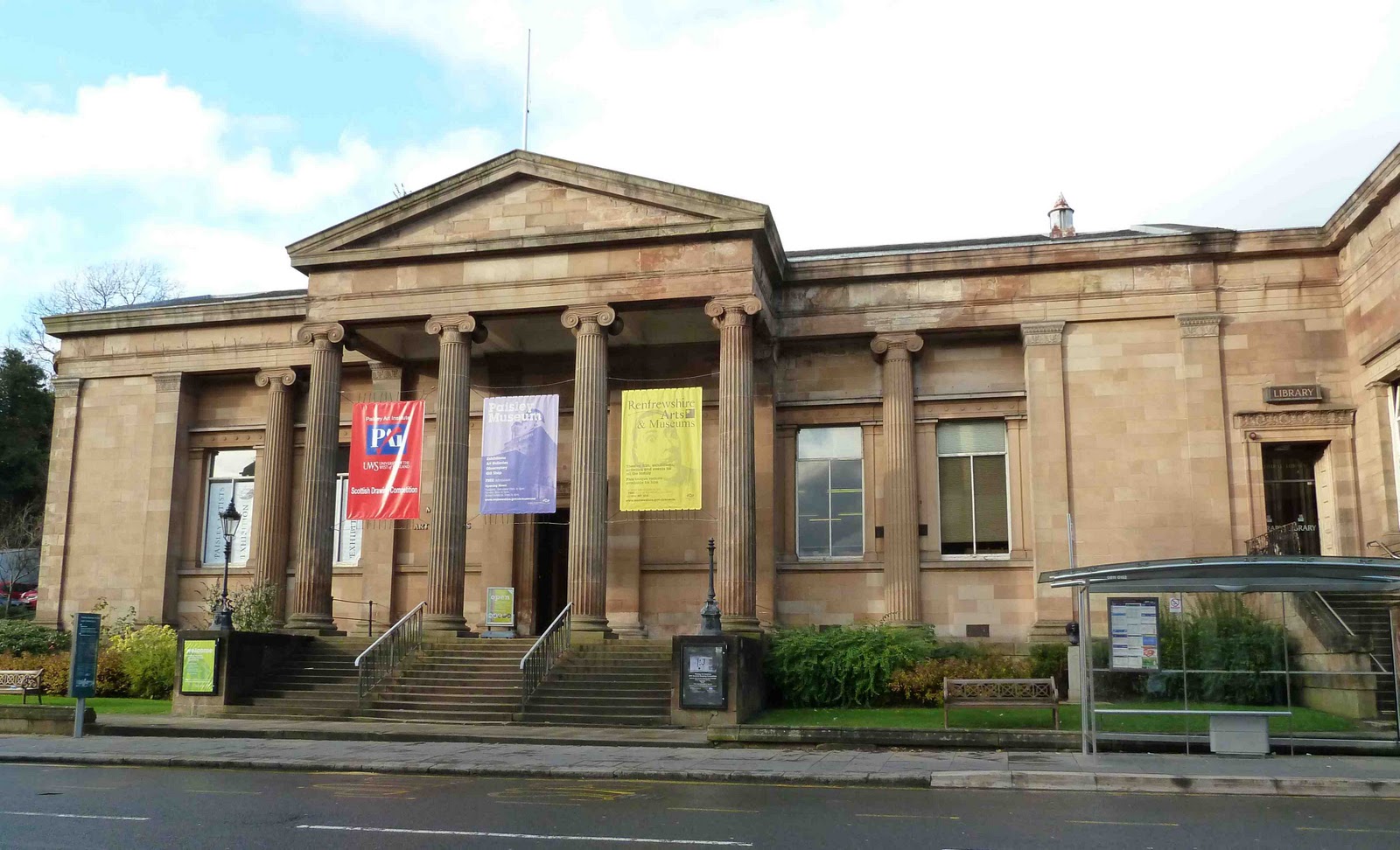
Paisley Museum & Library where the local studies collection is housed
When browsing a volume of poor relief applications I was particularly struck by the answers given in response to the question of ‘Religious Persuasion’.  These represented a wide range of religious denominations including Secessionists, Methodists, Baptists and Relief Church as well as reflecting Paisley’s large Irish population which included both Roman Catholics and Protestants (some described as Church of England or Episcopalian).
It seems to have been relatively common for husbands and wives to belong to different churches and what was perhaps surprising was the irregularity with which many people appear to have attended any church.  The following are a sample of answers found in volume B57/11/1 ‘Paisley Parochial Board: Statements of Cases’ which covers 1839-1842:
Mrs Archibald Gibson, aged 66
West Relief Church formerly, but never attended nor members for 30 years
Mrs Peter Docherty aged 31
Roman Catholic: self a member and husb[an]d is not
Walter Millar, aged 61
formerly in his younger days, he was a member of the Abbey Cl[ose] Independent
Widow William Cumming, 77
Church of Scotland: Once a Communicant but not so for some years
George Stewart, 40
Church of Scotland: but never has Communicated
Hellen Cavannah, 58
has a disposition towards the Roman Catholic faith; not a Member
Widow Thomas Campbell, 56
Protestant: Once attended but not so for many years
Widow Malcolm Turner, 76
neither herself nor husband were members of any church
It is worth noting that in Scotland, often only the fairly well-to-do were actually communicants or full members of a church (as opposed to simply attending) and it is not uncommon to find that a couple married in a particular church and had all their children baptised there without ever appearing on the communion roll.
However, given these answers, locating these people in any church records may well be a challenge and it is quite likely that many of them died prior to the start of statutory registration (1855).
I’ve often had the impression that my Scottish ancestors rarely darkened the door of any religious establishment.  Given this evidence, I may well be right!

Wednesday, 26 October 2011

On the verge of a new life...

I’ve just spent a busy but productive day at the ScotlandsPeople Centre and whilst researching a client’s family from Argyll came across this interesting entry in the Old Parish Register for Kilchrenan and Dalavich: 


OPR 517: Parish of Kilchrenan and Dalavich, Argyll 

Register of Marriages in the United Parishes of Kilchrenan and Dalavich 
1821 
June 5 Peter Macffarlane late at Airdchonnal & 
          Elizabeth Campbell at Kames. Were Married this day 
                            at the Manse of Kilchrenan by 
                            Mr William Fraser Min[iste]r 
                            and were furnised [sic] with a certifi-
                            cate of their Marriage & Moral 
                            Character as they with his Father 
                            and family are preparing for Emigrating 
                            to Upper Canada. 


It’s one of those times when the clerk thought to note down at bit more than just the bare facts and it paints an evocative picture of a young couple on the verge of a new life. I think Elizabeth must have been brave to leave her own family behind and head off into the unknown, but perhaps she couldn’t bear the thought of Peter sailing off without her!

Saturday, 8 October 2011

Getting Educated

Genealogy education is a topic that’s been on my mind quite a lot lately. Firstly, I just heard that I’ve successfully completed the Postgraduate Diploma in Genealogical Studies from the University of Strathclyde. Secondly, I’ve recently joined a ProGen Study Group and one of my first assignments was to draw up an education plan for the next few years. And finally, last month I attended an AGRA Associates Day in London where the main theme was Continuing Professional Development. 

I think it’s fair to say that education is a pretty hot topic in the genealogy world right now. I’ve read two articles on the subject in the last few weeks: 'A Qualified Success' by Suzie Grogan in the October 2011 issue of Family Tree Magazine (UK) and 'The Art of Teaching Genealogy' by Lisa A. Alzo in the September 2011 issue of Association of Professional Genealogists Quarterly. Geneabloggers Radio had a 'Back to School Special' devoted to genealogy education in August and Angela McGhie, administrator of the ProGen Study Groups, writes a blog, Adventures in Genealogy Education, devoted to the subject. 

It’s clear that there’s a great demand for education from genealogists, whether tracing their own families, researching professionally or aspiring to become professional. Not surprising perhaps as genealogists are typically people with a thirst for knowledge and, I suspect, generally optimists who believe that the answer to finding that elusive ancestor is out there somewhere, if only they knew where to look. 

Last year when I completed the Postgraduate Certificate in Genealogical Studies I wrote a post about my experience of the course. You can read that post here and much of what I said also holds true for the Diploma course. This year, whilst considering ideas for my continuing education, I thought I’d write a brief summary of available genealogy education options from a UK perspective. 

Long-term Courses 
For those seeking an in-depth programme of study lasting several years there are three main options in the UK. The University of Strathclyde Genealogical Studies Programme, The Institute of Heraldic and Genealogical Studies (IHGS) Correspondence Course in Genealogy and the University of Dundee Courses for Family and Local History (leading to a Postgraduate Certificate or Masters Degree). 

All of these courses are available online for distance learning. I don’t have personal experience of them all, but one of the main differences seem to be that the Strathclyde course involves intense study with assignments submitted to meet regular deadlines, whilst the IHGS course can be completed at the student’s own pace and the Dundee course is modular with students having some choice over what modules to complete and how many modules to undertake at a particular time. 

Short-term Online Courses 
For those looking for a shorter course, Dundee University also runs two online distance learning courses entitled Beyond the Internet and modules from it’s main genealogy course can be taken individually (although a £95 registration fee applies). 

The main provider of short-term online courses in the UK is Pharos Tutors who are currently offering about 40 individual courses on a variety of genealogical topics. The National Institute for Genealogical Studies is based in Toronto, Canada but offers courses on English, Irish and Scottish research from basic to advanced levels. Some courses are non-credit but others are credited and can be used to gain a Certificate in English, Irish or Scottish Records. Celia Heritage of Heritage Family History has created a 4-module e-Course which can be purchased and downloaded from her website

Short-term Local Courses 
There are many genealogy courses available throughout the UK which can be attended in person. These are typically provided by university lifelong learning departments, adult education programmes, family history societies, libraries & record offices and private individuals and range from beginner’s workshops to advanced courses on particular record types. 

Free & Low-cost Options 
The above courses, especially the long-term ones, involve a serious investment of time and money, which not everyone is in a position to make. However, one of the things which was stressed in both my ProGen reading and at the AGRA Associates Day was that genealogy education doesn’t have to involve an organised programme of study. I hadn’t previously viewed many of my activities related to genealogy as educational or fully appreciated how much I was learning all the time. Below are are few of the other ways us genealogists can educate ourselves. If you’re the type of person who regularly reads genealogy blogs then chances are you already participate in quite a few of them. 

Webinars are a topic I’ve heard a lot about lately, although they’ve yet to make much of an appearance in the UK. The Society of Genealogists held a webinar on Using Legacy Software a few months ago and hopefully there will be more to come. In the meantime, there are plenty of webinars available from the US which are relevant to genealogists worldwide. Legacy Family Tree is a major provider of webinars and if you are not able to attend live then many recorded ones are available from their website (in some cases they are available free for a limited time and can be purchased after that). GeneaWebinars provides details of upcoming genealogy webinars and a calendar to keep track of them all. 

FamilySearch Learning Center offers a growing collection of videos and recorded lectures, described as free courses. There are currently 66 in the UK category (some of which are actually lectures from The National Archives available elsewhere) and others, for example in Instructions and Methodology, which are not location specific. These range from the ‘5 Minute Genealogy’ series for beginners, to advanced topics lasting about an hour. A recent addition is Scotland’s Old Parish Registers: How to Access, Use and Interpret. Nick Barratt, editor of Your Family History magazine, has an online video series on YouTube called The Family History Show. So far there have only been a few pilot episodes but hopefully more will follow. 

Podcasts are a good way to keep up with the latest news in the genealogy world and to increase your knowledge. The Genealogy Guys Podcast and Genealogy Gems Podcast are both US-based but frequently cover UK news and sources. The BBC radio programmes Tracing Your Roots and Digging Up Your Roots can both be downloaded as podcasts (but only for a short time after they are broadcast) and Geneabloggers Radio can be listened to live online or downloaded as a podcast. The National Archives (UK) Podcasts are recordings of lectures held at TNA and cover family, military and social history. There are currently over 70 lectures in the family history section covering topics from 'Sources for Anglican Clergymen' to 'The Pub and the People'. 

Genealogy books and magazines are another good low-cost education option and you don’t necessarily have to buy them. A simple keyword search for ‘genealogy’ on my local library catalogue returns over 900 titles and whilst some of these are transcriptions and indexes (as well as duplicates) this still provides plenty of educational reading. Membership of most genealogy societies includes a subscription to the society’s journal and allows you to attend talks given by the society. Talks, lectures and workshops are also hosted by local history societies, libraries, archives and educational organisations and whilst these may not always be specific to genealogy they can help to broaden our genealogy education. 

At present, ProGen is the focus for my genealogy studies but my wider education plan involves most of these free and low-cost options. What about you? What other forms of genealogy education do you participate in?

Monday, 29 August 2011

The Scottish Genealogy Society's Black Book

Although I'm a member of the Scottish Genealogy Society, I don't often look at their website.  Today was one of the rare occasions when I did and I discovered a resource there of which I was previously unaware and which I thought was worth sharing.

One of the great resources of the Scottish Genealogy Society's library is the society's collection of monumental inscriptions.  This is claimed to be the largest collection in Scotland and includes many unpublished transcripts as well as publications produced by family history societies all over Scotland.

The Society has now made details of all their holdings relating to Scottish deaths and burials available online through The Black Book.  These are a series of pdf documents which can be viewed online or downloaded to your computer and which show what burial, death and monumental records and indexes are held at the library for each parish in Scotland.

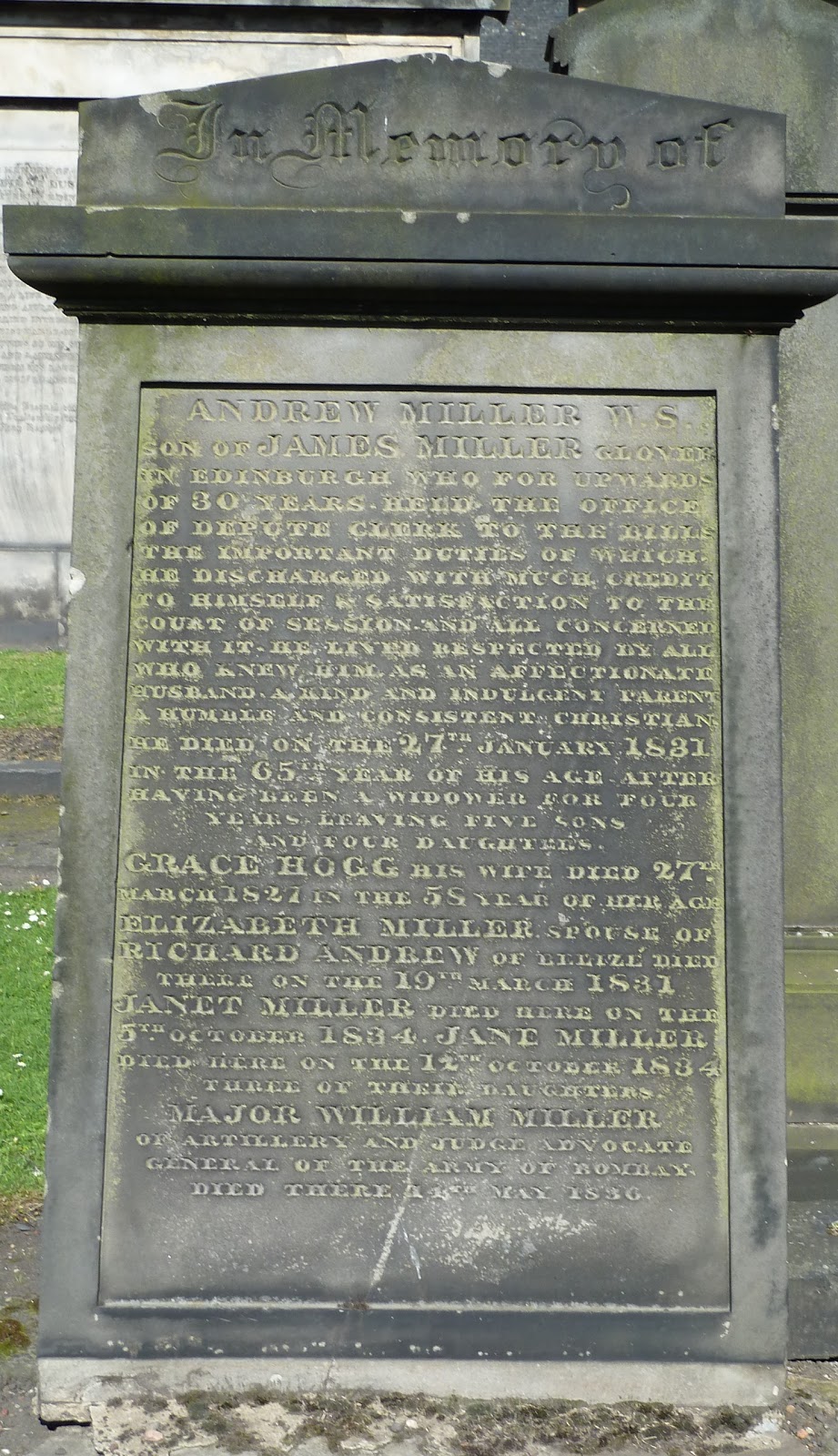
A Monument to the Miller family in Canongate Kirkyard, Edinburgh.

Even if you are not able to visit the Society's library in person to view the records and indexes, this acts as a very handy list of the majority of surviving records of Scottish deaths and burials prior to 1855.

Although not so comprehensive, it's also worth looking at the National Library of Scotland's Index of Published Monumental Inscriptions.  This includes details of some nineteenth-century publications containing monumental inscriptions as well as inscriptions published in journals such as Scottish Notes and Queries.  This index is only updated occasionally, however, so it is also recommended that you search the main library catalogue as well.

Whilst on The Scottish Genealogy Society's website don't forget that you can also download an index to The Scottish Genealogist journal covering 1953-2005 which includes plenty of articles on monumental inscriptions.

Happy searching!

© All images and text copyright Kirsty F. Wilkinson

Wednesday, 3 August 2011

Using LibraryThing for Genealogy

I have a confession. I buy books and never read them. I just can’t resist a second-hand bargain of some obscure history title that I may never see again or a new genealogy reference book that promises to help me break through that impenetrable brickwall. 

I have the best of intentions, but too often I just read the introduction, flick through a couple of chapters, then stick the book on my groaning bookshelves for "when I have more time". I’ve now reached the point where not only do I need a new bookcase, but I’ve also several times found myself in a bookshop looking at some inviting title and wondering if I already have it. 

Currently awaiting shelving.

I’ve recently seen a few of my Facebook friends discussing using LibraryThing as a way of cataloguing and sorting their book collection and decided to give it a try. I spent a few happy hours earlier this week going through my bookshelves and putting the majority of my history and genealogy titles online. 

According to Wikipedia, LibraryThing is a social cataloguing web application for storing and sharing book catalogues and various types of book metadata. For me, it’s a way of figuring out what books I actually have and, hopefully, the first step in becoming more organised and doing a bit more reading. 

LibraryThing is free to join, although if you want to enter more than 200 books you will need to upgrade your membership. A lifetime membership starts at as little as $19.00, depending upon your generosity. So far I’m at 193 books so may well be upgrading soon. 

You can choose to make your account completely private and only need to enter personal details if you wish. There’s a short introductory guide on the website but I pretty much just leapt straight in and got started entering books and found it very intuitive. 

I entered most of my books by ISBN number and then selected the matching edition from Amazon or one of the many available library catalogues, which include the National Library of Scotland. 

It turns out I have more books than I realised, including a few I don’t remember buying (‘The Scottish hosiery and knitwear industry, 1680-1980’???).  Despite it being rather an unexplored interest of mine, I apparently have 23 books on the history of the family (as opposed to family history), including four with sex in the title - well what Scottish genealogist could resist a book called ‘Scottish church attitudes to sex, marriage and the family, 1850-1914’! 

For me, the most useful feature is ‘collections’ which allows you to put each book you enter into one of the predefined categories or any other you choose to make up (I’ve yet to discover if there is a limit to the number of collections you can create or the number of collection you can place a particular book into). This means you can arrange your titles in a way that’s meaningful to you. 

For example, I’ve created an ‘Old Documents’ collection which includes my books on old handwriting, Latin and Scots dictionaries, glossaries of words useful for family and local historians, reference books such as ‘Dates and calendars for the genealogist’ and more general guides to particular records such as ‘Wills and Probate Records’. This means that when reading or transcribing an old document I now have a quick way of checking what books I have that may be of use. You could perhaps create a collection of books dealing with a particular country or region, or an area of research in which you specialise. 

I’m not sure how involved I’ll get with the social aspects of LibraryThing, but for now have made my account public and joined the Genealogy@LT group (yes, of course there’s a genealogy group!). I also signed in with my Twitter account which meant I could immediately see some familiar faces who were already using LibraryThing, although I’m not sure how to find that information again. I have come across some people whose names I recognise from other social media sites through having books in common. 

As all the books I’ve entered are genealogy or history related, the recommendations LibraryThing makes are fairly useful, although all the ones I’ve added to my ‘wishlist’ are books I’ve previously heard of but not got around to buying yet. 

If you are interested, you can find my book list at http://www.librarything.com/catalog/KirstyF.Wilkinson 

I’m currently looking at developing an educational plan (a ProGen assignment). It turns out that to improve my genealogical knowledge and skills I probably need look no further than my own bookshelf!

© All images and text copyright Kirsty F. Wilkinson

Wednesday, 13 July 2011

Wordless Wednesday - Happy Centenary Grandad

I have just been reminded by my Dad that today is 100 years since the birth of my paternal grandfather, Douglas Sykes Wilkinson (1911-1985).


Happy Centenary Grandad!


Grandad & Me